Voice API
From basic calling to conversational intelligence, build it with Twilio Voice API
Build a scalable voice experience with the Voice API that connects millions worldwide and turns every call into data and insight.

Our Voice API, your rules
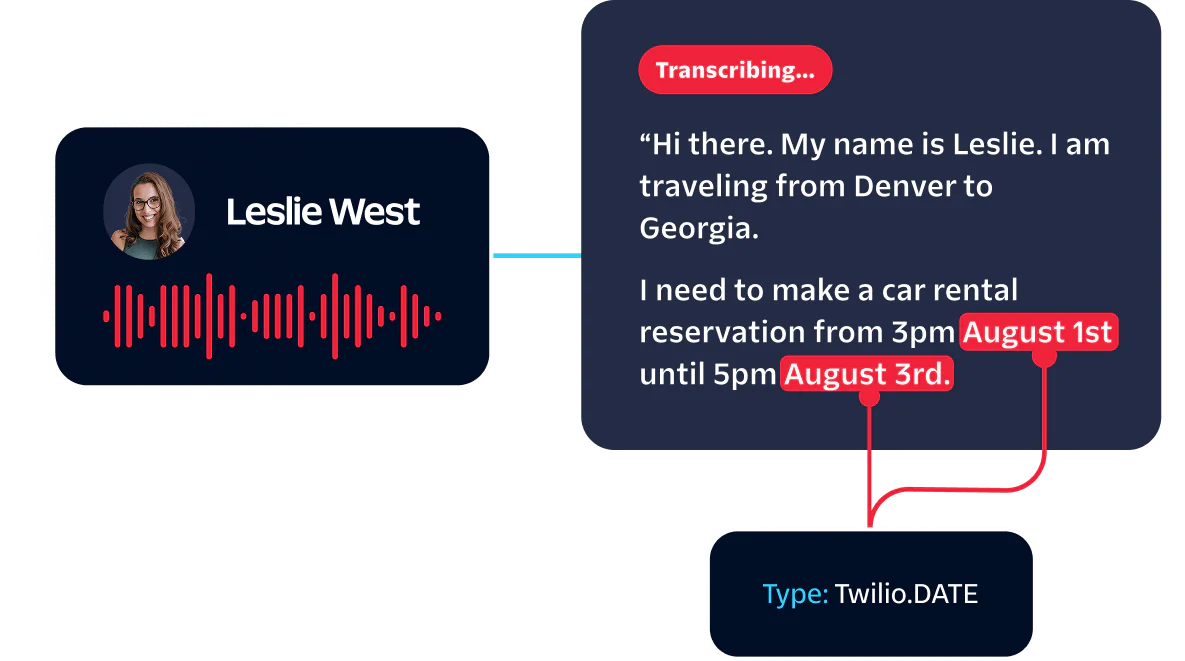
Build a voice experience that you can quickly scale. Then modify it with a range of resources, like our Voice SDK, and unlock new insights from your conversations with Conversational Intelligence.
Add features like Interactive Voice Response (IVR), voice recording, and speech recognition. And get connectivity you can trust through reliable, high-quality connections with the Twilio Super Network.
A Voice API that works everywhere you need it
Create stronger connections through any voice calling experience.

Turn “unknown number” into “trusted caller”
Combat distrust in voice calling—87% of consumers believe unidentified calls may be fraudulent. Prove your calls are trustworthy and increase answer rates.
Voice API Features
The Voice API that just works—and features that make it work even harder.

Sign up now
Unlock ROI from your customer calls with Conversational Intelligence
Turn conversations into knowledge and extract customer data at scale with natural language intelligence. Conversational Intelligence is your gateway to AI-powered business transformation.
-
Take advantage of unrivaled scaling and carrier redundancies in over 100 countries.
-
Upgrade your business agility by adding global PSTN connectivity and indefinite scaling.
-
Protect your communications with private, high-quality connections to the cloud.
-
Get secure, real-time access to the raw data of your phone calls.
-
Power calls with real-time quality insights. Spot trends, lift answer rates, and measure the impact of Branded Calling.
-
Quickly embed Voice into your iOS, Android, or Javascript applications.
Good conversations start with great code
Make your first outgoing phone call with just a few lines of code. Add a few more and your app can respond to incoming callers. Then choose your programming language for a quick and confident deployment.
Need help building? No problem.
Work with one of our trusted partners to get coding support or explore a pre-built voice solution. Find a partner
27.9B voice calls and counting (but who's counting?)
Handle your biggest voice workloads with reliable scale and quality.
27.9B+
calls handled in 20241
76M+
calls daily1
230+
number types1
50B+
voice minutes handled1
Voice API pricing that scales with you
Build the intelligent call experiences you’ve always wanted without worrying about the cost. Only pay for what you use. There are no commitments necessary.

Twilio Voice FAQs
A voice API is a tool that enables your web application to make and receive phone calls. It can immediately connect you to the Public Switched Telephone Network (PSTN) so you can call people anywhere in the world, on any device, through any network via an internet connection. It can also place calls over the internet, through VoIP calling, to reach applications connected to the internet.
A voice calling app is an application that can make and receive phone calls. It can connect you to the Public Switched Telephony Network (PSTN) and VoIP applications so you can reach people anywhere, on any device.
A voice calling application usually includes additional features and functionality, like call transcription, voice recording, interactive voice response (IVR), SIP interfacing, text-to-speech and more.
See more features you can build into a voice app.
Alerts and notifications - Automated phone calls to notify customers about password resets, low-balance alerts, upcoming appointments, and fraud warnings.
IVR - A custom interactive voice response system for self-service that can respond to commands, support text-to-speech in hundreds of languages, and route customers to the right representative when they need one.
Call tracking - A way to tie incoming calls to specific digital campaigns for ROI measurement, as well as routing leads to the right representative.
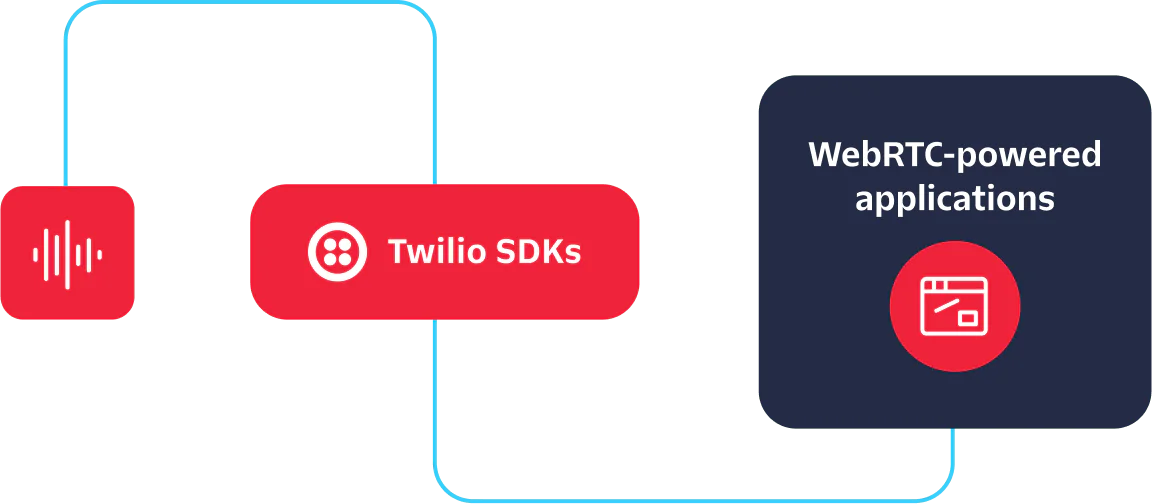
Embedded calling - A WebRTC-powered voice calling app that works across browsers and devices.
Global conferencing - Multiparty calling experiences for up to 250 participants.
Masked calling - A way to connect customers to employees without revealing the personal phone numbers of either parties.
Voice AI - Integrate voice AI agents that can handle common requests and intelligently route complex issues to the right person.
Yes. As a default security measure, Twilio Voice uses encryption at rest for call recordings stored with Twilio.
We also have a Call Recording Encryption feature that encrypts all records with a public key which can only be accessed by the holder of the corresponding private key.
Learn more about call recording encryption.
Twilio Voice is pay as you go, which means you pay based on the number of calls you make and call duration. There are different charges depending on the type of call you’re making, the number you’re calling, and the features you’re using.
You can visit our voice pricing page to see a detailed breakdown.
Twilio has a number of Voice AI features that let you build intelligent, automated voice experiences. Because our offering isn’t one-size-fits-all, you have the flexibility to add AI and automation where it makes the most sense for your customer experience.
Conversation Intelligence: AI-powered language operators and call transcription to extract important signals from customer conversations.
Speech recognition and text-to-speech: convert spoken language to text and vice versa in real-time.
Call transcription: record and transcribe calls for analysis, compliance, training, or to add to your customer memory.
Voice Insights: see call quality, network latency, jitter, and packet loss data along with AI-powered analytics to troubleshoot.
AI agent deployment: integrate your existing AI agents into call flows.
Learn more about Conversation Intelligence
You can implement the Voice API and make your first test call in under an hour if you’re building a basic calling app.
More complex use cases take longer to build. It may take a few days or up to a week to build an advanced voice app that uses call recording, ties into your IVR, or integrates with your existing systems or AI tools.
Twilio has extensive documentation, quickstarts, and SDKs that make it easy to get started and quickly go from proof of concept to production.
Twilio’s battle-tested infrastructure is trusted by 400,000+ businesses including 84% of the fortune 500. Our reliability, scalability, and maturity (we’ve been connecting calls since 2011) are some of the reasons businesses of all sizes choose Twilio.